


Why the UK Is Shifting from Importing Students to Exporting Education
May 27, 2026
 14:26:51
The UK has recently updated its higher education strategy, placing more focus on international expansion, transnational education, and bringing British degrees closer to students around the world. Rather than relying on student mobility, universities are increasingly being encouraged to export programmes through overseas campuses and partnerships.
But what does this actually mean for students? Could studying at an international branch campus offer the same opportunities as studying in the UK itself? And how are universities adapting their programmes to meet the fast-changing demands of local economies and global employers?
To better understand these changes from a student perspective, Studyportals spoke with Paul Julian Bennett, Chief Marketing Officer at British University Vietnam. Based in one of Southeast Asia’s fastest-growing education markets, Bennett shared insights into why British universities are increasingly expanding abroad, how BUV collaborates with UK university partners, and why employability and local industry needs are becoming central to international education strategies.

It is hard to look ahead 10 Years, but it 100% pays off
Studyportals: What is a higher education strategy, and why should students care about it?
Paul Bennett (BUV): Students should really think about what they need to learn and what skills and qualifications they need to build a successful career in ten years’ time. I know that if you’re 18, thinking ten years ahead is difficult. I have an 18-year-old daughter who’s about to go to university, and she says, “Dad, I can’t even think about next year. I don’t know where I’ll be when I’m 28.”
Still, understanding the value of getting the highest-quality qualification possible, while also making it accessible, puts students in a much stronger position in three important ways.
Understanding the value of getting the highest-quality qualification possible, while also making it accessible, puts students in a much stronger position
First, it gives them more choice in the future and opens up more career paths. Second, it gives them flexibility. A strong education and qualification allow students to move across roles and industries instead of being locked into a very narrow career path. Third, students and parents need to think carefully about value and return on investment, especially when considering an international qualification.
Studyportals: ROI, in simple words, what does that mean?
Paul Bennett (BUV): ROI stands for Return on Investment. It’s something many parents spend a lot of time thinking about, especially in Southeast Asia. If families are investing tens or even hundreds of thousands of dollars into education, they naturally want to know whether that investment will lead to strong career opportunities and long-term value.
I think students also have a responsibility to think carefully about value for money. Education requires time, effort, and often a significant financial sacrifice from families, so it’s important to make sure the qualification delivers the best possible outcome.
Studyportals: This pretty much means the amount of money you can earn after you graduate and how long it might take to use that money to cover what your parents paid for your studies.
Well, honestly, my daughter wouldn’t be thinking about covering any expenses I might incur. But as the parent of an 18-year-old, what I want is to give her the opportunity to earn the best qualification possible, one that gives her as secure a future as possible. And that’s what many parents want, certainly across Southeast Asia: to invest in their children and help them have better opportunities than they themselves might have had.
That kind of legacy doesn’t necessarily mean my daughter paying me back financially. I hope many students understand that their parents want them to have more success and a better life than we had. It’s kind of a “pass it on” legacy.
I genuinely think that’s where higher education becomes important. And I think, to an extent, particularly from a Southeast Asian perspective, having access to really high-quality qualifications from countries like the UK or the US gives you that extra edge when you’re job hunting, and will certainly give you that extra edge when you’re competing for promotions in the future.

Exporting education vs importing students. The British model
Studyportals: As you mentioned, strategies are about thinking ahead, maybe five, ten, or fifteen years into the future. The UK already had a higher education strategy, but this updated version introduced some important changes. What changed?
Paul Bennett (BUV): My impression is that much of the change comes down to local politics. This is true in the UK, but also in countries like Australia and the United States. The idea of a highly connected world with open migration feels less accepted today than it did one or two decades ago.
In the UK particularly, the government has decided to reduce the number of visas issued to international students and place more restrictions on graduates staying in the country after finishing their studies.
This is something I also saw during my time working in Australia. Previously, students could complete a three-year undergraduate degree, stay longer, and potentially apply for permanent residency after several years. That pathway created opportunities for students from Southeast Asia, China, or India to build a new life abroad.
Now, those opportunities are becoming more limited. As a result, the UK government has encouraged universities to export their education model instead of importing students. In other words, bring the same quality education and qualifications closer to students in their home regions.
The UK government has encouraged universities to export their education model instead of importing students. In other words, bring the same quality education and qualifications closer to students in their home regions
Personally, I think this makes economic sense because it increases accessibility. For many students in Southeast Asia, Africa, or South America, studying in countries like the UK or Australia is prohibitively expensive. Tuition fees are extremely high, exchange rates are difficult, and accommodation and living costs are also expensive.
The British government has been quite smart in encouraging universities to take their education overseas.
The university I currently work for, the British University Vietnam, has a particularly interesting model. In many cases, the UK government encourages universities like the University of Southampton to open campuses in countries such as Vietnam, Malaysia, or Thailand. But building a campus abroad takes a long time because of regulations and approvals, and it also limits student choice because students can only access that one university’s qualifications.
At BUV, we operate differently. We’re a teaching university with seven university partners. At one end, we work with institutions like the University of London and the London School of Economics and Political Science, and we teach their qualifications directly in Vietnam. We also partner with institutions such as University of Stirling, Arts University Bournemouth, Bournemouth University, Manchester Metropolitan University, and Staffordshire University.
This gives students in Vietnam much more choice in terms of rankings, tuition costs, and programme complexity.
Studyportals: So you basically take specific programmes and curricula from multiple universities and integrate them into BUV Vietnam?
Paul Bennett (BUV): Exactly. A good example is our business school. Vietnam is one of the fastest-growing economies in the world, so business-related disciplines are extremely popular and important.
Students can study business management, marketing communications, or professional communication degrees from different universities while staying on the same BUV campus. For example, a student could choose a communications degree from Staffordshire University, Manchester Metropolitan University, or the University of London.
That means students have more flexibility, more price options, and access to international qualifications without needing to leave Vietnam.
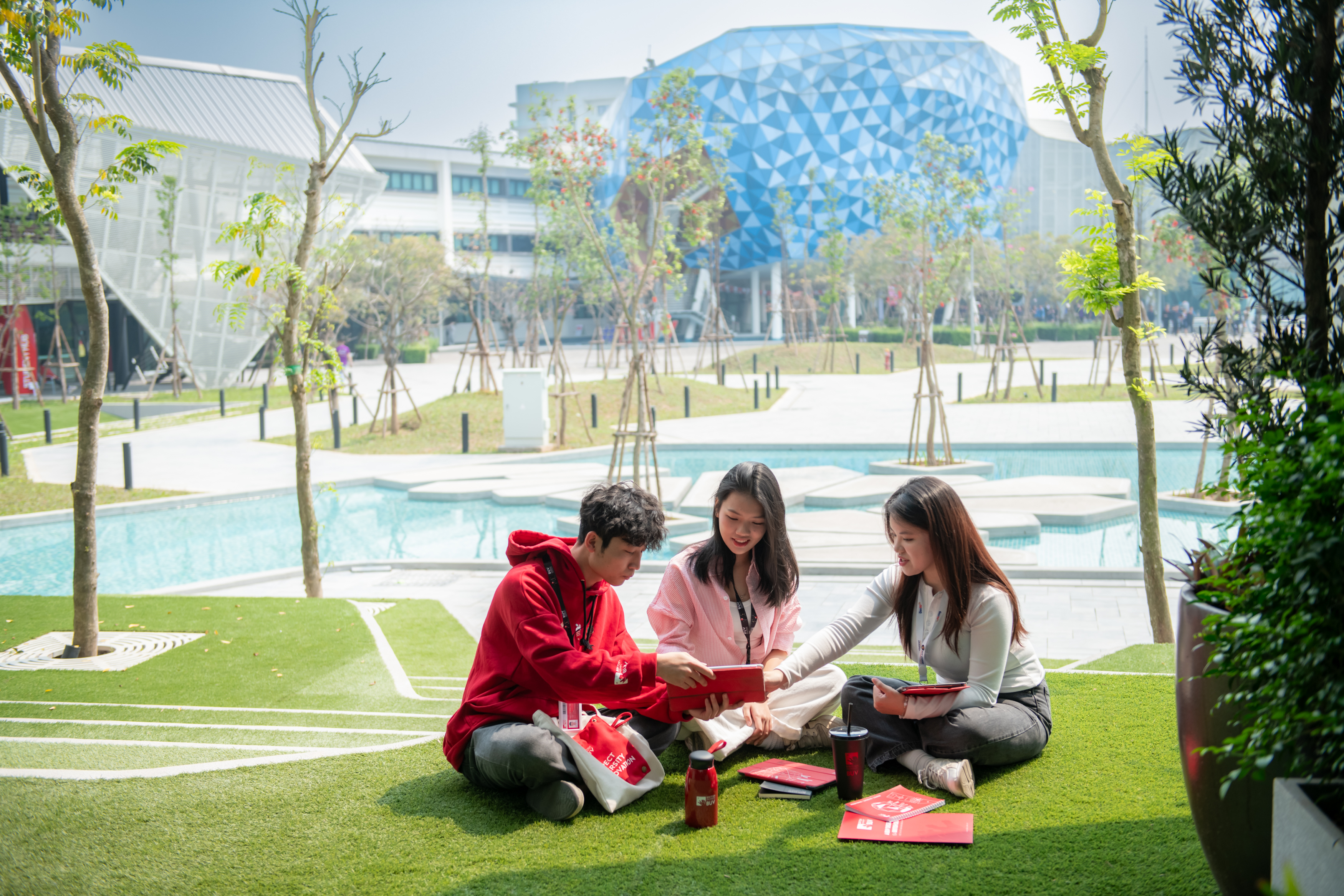
Giving students more choice, closer to home
Studyportals: You’ve recently built a major new campus in Vietnam, which is clearly a long-term investment. Why Vietnam? Why not Singapore, Malaysia, or another country?
Paul Bennett (BUV): There are several strong reasons. First, Vietnam currently has one of the fastest-growing economies in Southeast Asia, and it has maintained very strong GDP growth for the past seven or eight years. In fact, Vietnam’s economy is currently growing faster than China’s economy ever did year-on-year and faster than India’s as well.
That’s important because it has attracted enormous international investment. Global companies recognise that Vietnam’s middle class is growing rapidly and that the market is huge. Vietnam has around 112 million people, nearly twice the population of the UK, and roughly half the population is under 35. It’s a very young, energetic country.
Vietnam is also strategically positioned in Asia. China is nearby, India is nearby, and Singapore is only a short flight away. Many companies now see Vietnam as a central hub for expansion into the wider region.
Another important factor is the government’s commitment to education. Recently, we joined a Vietnamese delegation to China, where we signed several memorandums of understanding with Chinese universities to support collaboration and student exchanges.
The owner of our university is also one of the largest education providers in Asia. He owns the Taylor’s Education Group and has spent more than 35 years building a highly integrated education network. Around three years ago, he invested approximately $165 million into building our new campus.
I honestly believe the campus is world-class. When you walk through it, it feels comparable to major campuses in places like Texas or leading universities in China. Even though we currently have around 4,000 students, the facilities compete with universities that have tens of thousands of students and major government funding.

Our business model is focused on giving students more choice while helping them stay connected to their families and local environment.
There’s also another important point. If students study abroad, most of the case studies, guest lecturers, and business examples they encounter are based on the UK or another foreign market. So students gain the qualification, but not always the local business context.
A Vietnamese employer might look at a graduate returning from the UK and say: “Great qualification, but you don’t fully understand the Vietnamese market.”
What’s interesting about our model is that students still receive the same qualification and academic structure, but the context is local. Students gain a Southeast Asian learning experience while studying an international curriculum.
Studyportals: You obviously need to work closely with businesses, sign agreements with companies and government bodies, and build long-term partnerships. How does that process work, and can you give us some insight into how you manage to provide students with this kind of practical experience?
One of the things we’re certainly investing more in as the university grows is our corporate and industry engagement capability. We currently work with about 500 companies, around 150 of which are global organisations like Bosch, Panasonic, and HSBC, but also major Vietnamese businesses like Vingroup.
If you think about Hyundai as a titan in Korea, Vingroup is a similar kind of multifaceted conglomerate. They make cars, build housing estates, own hotels, and operate across many sectors.
So, we’ve built corporate relationships with almost all of those 500 companies. My ambition is that, within the next three years, not only will that network grow, but we’ll also establish deeper relationships with many of those organisations.
In fact, the Vice Chancellor and I were talking about this the other day. His vision is that students walk off the graduation stage here at BUV and straight into the arms of the company that’s going to employ them.
At the moment, we’re working very collaboratively with industry partners and running a variety of sophisticated internship-matching programmes. For example, if you’re studying hospitality and need to complete an internship, we work closely with partners such as InterContinental Hotels Group and others to ensure students don’t end up washing dishes or being treated as free labour during a summer placement.
Instead, our students shadow three or four different managers across several operational areas of the business. Then they bring that experience back into the classroom.
We work closely with partners to ensure students don’t end up washing dishes or being treated as free labour during a summer placement. Instead, our students shadow three or four different managers across several operational areas of the business. Then they bring that experience back into the classroom
It’s a hugely important part of our overall value proposition. We want every student not only to gain real-world experience and meaningful internships during their studies, but also to leave university with a genuine opportunity to move directly into employment.
Studyportals: Your strategy seems to focus heavily on connecting academic programmes with real job market needs. How does that work in practice?
Paul Bennett (BUV): Yes, absolutely. One of the projects we’re currently leading together with Vietnam’s Ministry of Education and Training is a national employability study.
We’re speaking with around 400 high-growth companies, including their HR and strategy departments, to identify the academic, practical, and human skills they’ll need from future employees.
One example is that every inbound student joining us in 2026-27 will receive an international experience funded through their tuition. We’ll send students to China, which is currently one of the world’s most advanced AI markets, where they’ll spend two weeks visiting companies that are already using AI in transformative ways.
Our goal is not only to import programmes from the UK that match Asia’s growth sectors, but also to adapt parts of the learning experience to meet the exact needs of employers.
A good example is Hanoi’s future metro system. Hanoi is a city of around 10 million people, yet it still doesn’t have a metro network like London or New York. The Vietnamese government has committed to building one over the next 25 years.
We’re already speaking with the companies involved in those projects to understand what kinds of graduates they’ll need in three to five years. Based on that, we’re looking at programmes in logistics, business management, AI, and technology to make sure students develop the right skills for those future jobs.
Link to the full article: https://www.mastersportal.com/articles/3555/interview-paul-bennett-british-university-vietnam-uk-strategy-study-abroad.html
- Share


 Read more
Jul 17, 2026
LSE Vice President and Pro Vice-Chancellor (Education): “BUV students among the world’s top achievers are a testament to a partnership built on academic excellence”Professor Emma McCoy, Vice President and Pro Vice-Chancellor (Education) at the London School of Economics and Political Science (LSE), highlighted BUV students’ consistent global academic achievements as evidence of the university’s long-standing partnership with LSE, demonstrating how world-class British education can be delivered in Vietnam through rigorous academic standards and strong local collaboration. During her […]

Jul 02, 2026
UK students drive sustainable innovation at BUV’s Heritage Design Thinking HackathonNearly 70 students from nine UK universities transformed two weeks of cultural immersion into innovative ideas to preserve Vietnam’s cultural heritage and promote sustainable tourism at BUV’s Design Thinking Hackathon this June. Rather than developing ideas in the classroom, participants built business concepts inspired by first-hand experiences with Vietnam’s communities, heritage sites and local culture. […]

Jul 01, 2026
Cross-sector partnership to support Vietnam’s global gaming ambitions through world-class talent developmentAs Vietnam’s online gaming industry sets its sights on becoming a multi-billion-dollar market, British University Vietnam (BUV) hosted the forum “Vietnam’s Gaming Future: Industry, Education, and Innovation in Partnership”. The forum welcomed Mr. To Hong Nam, Deputy Director General of the Department of Science, Technology and Innovation under the Ministry of Education and Training; Ms. […]

Jun 30, 2026
Summer Show 2026 reflects the nuanced perspectives of young creative talentsThe Summer Show 2026, an annual graduation exhibition organised by the School of Communications and Creative Industries at British University Vietnam (BUV), offers a completely different perspective on the intellectual depth and courage of the younger generation. This year exhibition’s theme is inspired by the concept of “INTERFORM” which is a space where different forms […]

Jun 25, 2026
British Ambassador to Vietnam: “BUV’s Culture Immersion Programme is a brilliant example of the UK–Vietnam partnership”“Transnational education is a key priority for the UK, and BUV has a fantastic offer that really shows the quality, the focus on partnership and international collaboration, and the focus on the future,” emphasised H.E. Iain Frew, British Ambassador to Vietnam. This June, nearly 70 students from nine UK universities gathered at the British Ambassador’s Residence in Hanoi for a special […]

Jun 24, 2026
National Survey on Generative AI in Vietnamese Higher EducationThe Centre for Research and Innovation (CRI) at British University Vietnam (BUV), in collaboration with Swansea University (UK), is inviting lecturers, students, and higher education administrators across Vietnam to participate in a national survey on the use of Generative Artificial Intelligence (GenAI) in higher education. The survey is part of the international research project Bridging […]

Jun 18, 2026
BUV Launches New Programme for Full-Stack Game Developers of the FutureAs the boundaries between technology and creativity continue to blur in the gaming industry, this billion-dollar market is demanding a new generation of talent equipped with more diverse skill sets than ever before. With approximately 54 million gamers and nearly 5 billion game downloads annually, Vietnam is one of the fastest-growing gaming markets in the […]

Jun 11, 2026
Games Nexus 2026: Turning Passion into Products to Elevate Vietnam’s Game IndustryAs Vietnam’s game industry shifts from competing on scale to competing on quality, Games Nexus 2026, organised by BUV, provided students with opportunities to connect with industry professionals, develop career-ready skills, and prepare for future roles in the game industry. Vietnam’s gaming sector is experiencing rapid growth. According to a report by GameGeek, Vietnam’s mobile […]

Jun 05, 2026
Creating Happiness Through Quality: How a University in Vietnam Can Reach International StandardsAs human development and quality of life are increasingly emphasised in the major directions of the Party and the State, higher education is also facing an important question: how can universities not only train human resources, but also create an environment where learners can develop holistically, feel connected, and be ready for the future? The […]

Jun 04, 2026
BUV and Hue University partner to expand international learning pathways for students in Central VietnamBritish University Vietnam (BUV) and Hue University have officially signed a Memorandum of Understanding (MOU), laying the foundation for academic cooperation, cultural exchange, student progression, and the development of international partnerships between the two institutions. The signing ceremony was attended by Dr Bui Van Loi, Vice President of Hue University; Professor Rick Bennett, Vice President […]